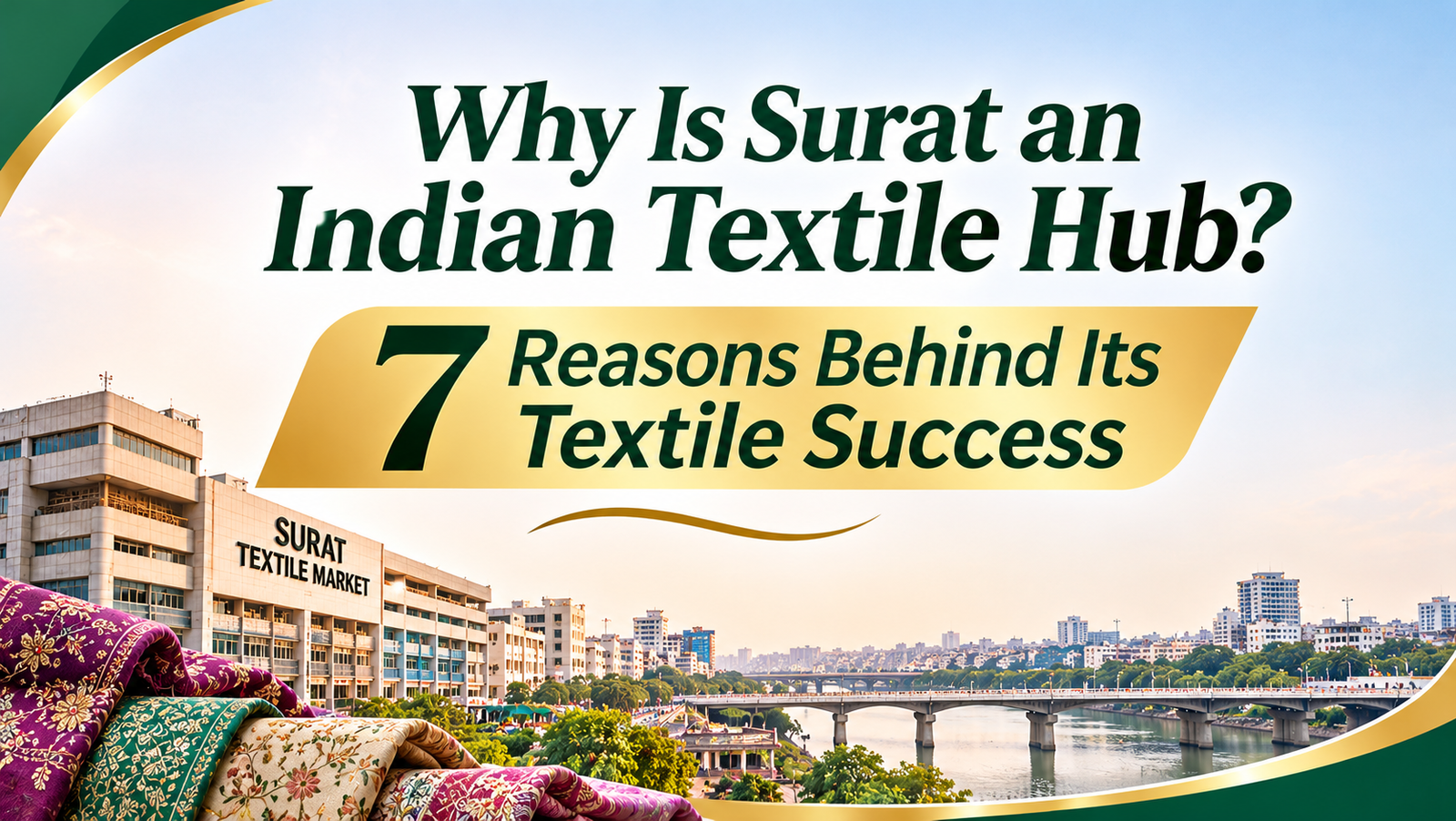
Why is Surat an Indian textile hub? The answer lies in its long trading history, extensive fabric manufacturing network, specialised textile processing units and wholesale markets. Located in Gujarat, Surat has developed into one of India's most important centres for synthetic and man-made fabrics, bringing weaving, dyeing, printing, embroidery and textile trading together in one industrial region.
For international buyers, Surat is more than a city with large fabric markets. It is a textile sourcing ecosystem where different businesses handle different stages of fabric production. A garment manufacturer can source woven material, arrange printing and explore embroidered fabrics through specialised suppliers operating within the same region.
Companies such as Ajmera Fabrics, based in Surat, are part of this wholesale textile industry, connecting fabric manufacturing and sourcing activities with business buyers in India and international markets.
Why Is Surat Called the Textile Hub of India?
Surat is widely known as a textile hub because of its concentration of textile manufacturing, processing and trading businesses. The city is particularly important for synthetic fabrics and polyester-based textiles used in clothing and other applications.
Unlike a location that specialises in only one stage of manufacturing, Surat has businesses involved in yarn-related activities, fabric weaving, dyeing, printing, embroidery, finishing and wholesale distribution.
This industrial network allows different textile specialists to work within a connected supply chain. It also gives buyers access to fabric varieties, processing options and trading services without depending entirely on a single large mill.
However, not every textile company in Surat performs all these activities itself. Many businesses specialise in particular processes or coordinate work through manufacturing partners.
1. Surat Has a Long History of Textile Trading
Surat's connection with textiles did not begin with modern polyester manufacturing. The city has a long commercial history, and textile trading formed part of its development as an important business centre.
Historically, Surat was associated with silk, brocade, zari work and other textiles. Over time, changes in textile technology, consumer demand and industrial investment helped transform the city's manufacturing activities.
As synthetic fibres became more widely used in clothing, Surat developed a strong position in man-made fabrics. This expansion added new manufacturing capabilities to an existing trading culture.
That combination of commercial experience and industrial specialisation is one reason the city continues to attract textile businesses.
2. A Strong Synthetic and Polyester Fabric Industry
One of the main reasons Surat is recognised internationally is its concentration of synthetic textile manufacturing.
Polyester and other man-made fibres can be processed into fabrics with different weights, textures, finishes and appearances. These materials are used across multiple clothing categories, including dresses, blouses, sarees, lining materials and selected fashion textiles.
Surat's textile ecosystem includes a large number of businesses involved in weaving and processing these materials.
For wholesale buyers, this specialisation is useful because two polyester fabrics can behave very differently. One may be lightweight and flowing, while another has a firmer structure. A buyer should therefore compare composition, fabric weight, usable width and finishing rather than purchasing based on the word polyester alone.
Surat-based suppliers such as Ajmera Fabrics offer wholesale polyester fabric collections that buyers can review for different garment applications, subject to confirming the specifications of each product.
3. Weaving, Dyeing and Printing Businesses Work as a Cluster
A major strength of Surat is that its textile industry operates through specialised manufacturing clusters.
Fabric production does not always happen under one roof. A weaving unit may produce unfinished material, commonly called grey or greige fabric. That fabric can then move to a processing facility for dyeing, printing, washing or finishing.
After processing, the fabric may undergo additional work before reaching a textile trader, distributor or clothing manufacturer.
Industrial areas around Surat, including Pandesara, Sachin, Kadodara and Palsana, are associated with different textile production and processing activities.
For a buyer, the advantage is access to a network of specialised services. The limitation is that every stage must be coordinated carefully. If printing, processing and inspection are handled by different businesses, responsibilities should be clear before the order begins.
4. Surat Is Known for Fabric Printing and Embroidery
Fabric printing and embroidery are important parts of Surat's textile identity.
Printing can transform a plain fabric into a finished fashion textile using colours, motifs and repeat patterns. Different production facilities may specialise in digital printing, rotary printing or other processes, depending on their machinery and products.
Embroidery adds another layer of design and value. It is used in different textile and garment categories, including occasion wear, decorative fabrics and ethnic clothing.
This manufacturing diversity is useful for clothing businesses developing printed or embellished collections. A brand may begin with a particular fabric construction and then evaluate appropriate printing or embroidery options.
However, buyers should check colour consistency, print registration, embroidery placement and the finished fabric's behaviour after washing.
A decorative design may look attractive in a catalogue, but its suitability for garment production depends on more than appearance.
5. Surat Has an Extensive Wholesale Textile Market
Manufacturing alone does not explain Surat's importance. Wholesale textile trading has also helped establish the city as a commercial sourcing destination.
The Ring Road textile market area is well known for businesses dealing in fabrics, sarees, dress materials and related textile products.
These markets connect traders, manufacturers, distributors and clothing businesses. They help commercial buyers compare designs and explore different sourcing options.
For an international importer, the advantage of a large wholesale market is the opportunity to evaluate multiple product categories. But a large market does not guarantee that every supplier offers the same quality or commercial terms.
Buyers should confirm whether they are dealing with a manufacturer, an authorised distributor or a textile trading business. It is equally important to obtain the correct fabric specifications and approved samples.
6. The Textile Industry Supports a Wider Business Ecosystem
Surat's textile industry depends on more than the businesses producing fabric.
Transport operators, packaging suppliers, warehouse businesses, machinery technicians, chemical suppliers, traders and logistics companies all contribute to the textile supply chain.
This supporting network helps fabrics move between manufacturing units, processing facilities and wholesale customers.
For example, a fabric may pass through weaving, printing, inspection and packing before it is dispatched to a buyer. Each stage requires suitable handling and coordination.
This is one reason Surat has remained a major textile centre over time. Its manufacturing capacity is supported by a wider commercial ecosystem rather than isolated factories.
7. Surat Connects Indian Fabric Supply with International Buyers
Surat's textile industry also provides sourcing opportunities for international businesses.
Fabric buyers in the UAE, Saudi Arabia, Qatar, Oman, Kuwait, the UK, the USA and other markets may explore Surat suppliers when looking for synthetic, printed or decorative textile materials.
International customers often have different requirements from domestic traders. They may need clearly documented fabric composition, consistent product specifications, appropriate packaging and export documentation.
The ability to manufacture and source fabric is therefore only one part of international trade. Successful fabric exporting also involves commercial agreements, inspection, shipping arrangements and compliance with the destination country's requirements.
Buyers should select suppliers who can explain these responsibilities clearly rather than assuming that every wholesale trader handles international shipments.
What Types of Fabrics Are Manufactured in Surat?
Surat is particularly associated with synthetic and man-made fabrics, although businesses in the wider textile sector may also work with other materials.
Polyester Fabrics
Polyester fabrics are produced in different constructions and finishes for a wide range of clothing uses. Buyers should review weight, width, texture, opacity and care requirements before selecting a quality.
Viscose and Blended Fabrics
Viscose and selected blended textiles are used in garments that need particular levels of softness and drape. Their performance depends on the exact fabric construction, composition and finishing.
Printed Fabrics
Printed textiles are an important part of Surat's fashion fabric industry. They include different patterns and finishes, with production requirements varying according to the base material and printing process.
Embroidered Fabrics
Embroidered materials are relevant to decorative garment manufacturing and occasion-wear collections. Buyers should evaluate embroidery stability, usable fabric width and the effect of decorative work on the finished garment.
Why Do International Fabric Buyers Consider Surat?
International buyers may consider Surat because of its concentration of textile manufacturing, product specialisation and wholesale sourcing businesses.
For a garment manufacturer, comparing available fabric qualities is often easier when the relevant suppliers operate within an established textile region.
A clothing brand may need printed fabric for dresses, a wholesale distributor may require a range of polyester qualities, and an occasion-wear manufacturer may look for embroidered textiles.
These businesses have different purchasing requirements, even when they source from the same city.
The best approach is to begin with the garment or textile application, then identify suppliers whose products and manufacturing arrangements match those needs.
Surat Fabric Suppliers for UAE and Saudi Arabia
The UAE and Saudi Arabia are relevant international markets for Indian textile businesses.
Garment factories and textile traders in Dubai, Sharjah, Abu Dhabi, Riyadh, Jeddah and Dammam may source different fabrics depending on their customers and manufacturing activities.
For example, a modest fashion manufacturer may need fabric with suitable coverage and drape, while a textile distributor may focus on supplying several fabric varieties to different businesses.
Before importing, buyers should verify product samples, fibre composition, usable width, colour requirements, packing details and commercial shipping terms.
It is also important to check applicable customs and product requirements in the destination country.
How Is Surat Different from Other Textile Centres in India?
India has several important textile manufacturing locations, but they do not all specialise in the same products.
Surat is especially associated with synthetic fabrics, printing, embroidery and textile wholesale trading.
Other centres, including Tiruppur, Ahmedabad and Panipat, have different industrial strengths, such as knitted apparel, denim and woven textiles, or home textiles.
For buyers, the comparison should be based on the product category rather than assuming one city is universally better.
If a company needs printed polyester fabrics, Surat may offer suitable sourcing opportunities. A business purchasing knitted T-shirt fabric or home furnishing products may need to evaluate other manufacturing clusters as well.
Challenges Facing Surat's Textile Industry
Like other manufacturing industries, Surat's textile sector faces business and environmental challenges.
Energy costs, raw material prices, international competition and changing demand can influence textile production and pricing.
Textile dyeing and processing also require careful management of water, energy and wastewater. These issues are particularly important for processing units handling chemical treatments and coloured fabrics.
For international buyers, responsible sourcing means asking relevant questions about product quality, testing and environmental compliance where required.
Manufacturing scale is useful, but dependable quality and transparent business practices are equally important for long-term textile sourcing.
Ajmera Fabrics and Surat's Wholesale Textile Industry
Ajmera Fabrics operates from Surat, Gujarat, within the city's established fabric manufacturing and trading environment.
The company offers wholesale fabric collections that include polyester, viscose, printed and embroidered textile categories.
For international fabric buyers, the most practical starting point is to review the available materials and match their specifications with the intended garment or textile application.
Buyers should confirm composition, fabric weight, usable width, designs, finishing and availability before proceeding with a commercial purchase.
Businesses interested in sourcing from Surat can submit their requirements through the Ajmera Fabrics wholesale enquiry page to discuss suitable fabric options and export arrangements.
Conclusion: Why Is Surat an Indian Textile Hub?
Surat became a major textile hub through a combination of history, industrial development and commercial specialisation.
Its strength comes from the connection between weaving, dyeing, printing, embroidery, wholesale trading and supporting logistics services. Together, these activities have created one of India's most significant synthetic textile manufacturing clusters.
For international buyers, Surat offers a wide range of sourcing possibilities, particularly in printed, synthetic and decorative fabrics.
The answer to why Surat is an Indian textile hub is therefore not simply the number of textile markets or factories in the city. It is the industrial network connecting material production, processing, wholesale trading and global textile supply.
Frequently Asked Questions About Surat's Textile Industry
Why is Surat famous for textiles?
Surat is famous for its large synthetic textile industry, fabric weaving, dyeing, printing, embroidery and wholesale trading network. These activities make it one of India's major textile manufacturing centres.
Why is Surat called the textile hub of India?
Surat is called a textile hub because it has an extensive concentration of businesses involved in synthetic fabric manufacturing, processing, decorative textile work and wholesale distribution.
Which fabrics are Surat manufacturers known for?
Surat is particularly known for polyester and other synthetic fabrics, printed textiles and embroidered materials. Individual suppliers may specialise in different fabric categories.
Where are the major textile industrial areas in Surat?
Industrial areas including Pandesara, Sachin, Kadodara and Palsana are associated with textile manufacturing and processing. The Ring Road area is an important centre for wholesale textile trading.
Can international buyers import fabric from Surat?
Yes. International buyers can source fabrics from Surat-based suppliers, subject to product availability, approved specifications, export arrangements and applicable import requirements in the destination country.
Is Surat better than other Indian textile cities?
It depends on the product. Surat is especially relevant to synthetic, printed and embroidered fabrics, while other Indian textile centres may offer stronger specialisation in knitted apparel, denim or home textiles.
How can I find a wholesale fabric supplier in Surat?
Start by identifying the required fabric composition, weight, width, colour and application. Then review supplier catalogues, request samples and confirm commercial supply arrangements before ordering.