International fabric sourcing from India often begins with a simple question: should you look for suppliers in Surat or Mumbai?
Imagine you run a garment manufacturing business in Dubai. You need printed polyester fabric for a new collection. A Mumbai trader offers a design you like, while a Surat supplier offers a similar quality with information about the fabric construction, printing and finishing. Both quotations look reasonable. Which supplier should you choose?
The answer depends on more than the price per metre.
For overseas buyers, fabric specifications, product consistency, shipping arrangements and supplier communication can make a much bigger difference than the city printed on a business card.
Surat and Mumbai are both important textile business centres in India, but their strengths are different. Understanding that difference can help importers avoid expensive purchasing mistakes.
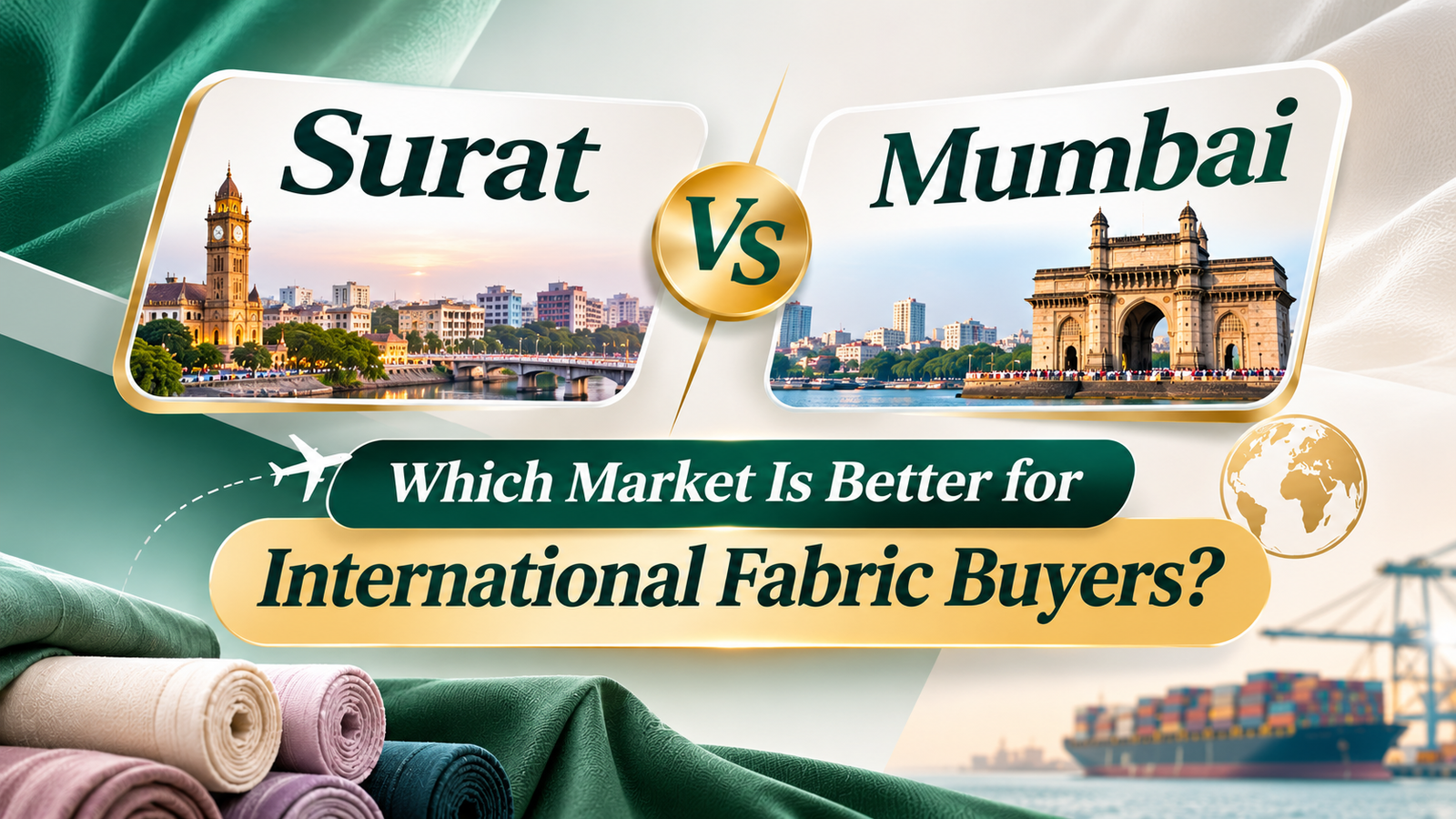
Surat vs Mumbai for International Fabric Sourcing: The Short Answer
Surat is generally the stronger starting point for overseas buyers looking for synthetic, polyester, printed and certain processed fabrics. Its established manufacturing network connects weaving, dyeing, printing, embroidery and wholesale supply.
Mumbai is useful for buyers looking to compare fabrics through established trading markets, especially when they need assorted materials from different sources.
Neither city guarantees a better supplier. However, when the requirement involves specific synthetic fabric qualities, manufacturing coordination or repeat sourcing, Surat offers a meaningful advantage.
Why Surat Attracts International Fabric Buyers
Surat's reputation is supported by industrial activity, not just wholesale showrooms.
According to WRI India, Surat produces nearly 40% of India's synthetic fabric and has more than 400 dyeing and printing units. This figure relates specifically to synthetic textiles, not every type of fabric produced in India.
For an overseas buyer, that concentration matters. It means Surat has an established network of businesses involved in producing and processing the types of textiles used in many garment categories.
Take printed polyester as an example. The base fabric may be woven by one unit, processed by another and finished according to a particular application. A supplier familiar with this network can help a buyer discuss different qualities and production requirements.
Of course, not every company manages all these activities itself. Buyers should ask which operations are handled directly and which involve production partners.
What Makes Mumbai Useful for Wholesale Fabric Importers?
Mumbai has a long commercial history in India's textile trade.
Areas such as Mangaldas Market and Mulji Jetha Market in Kalbadevi bring together wholesale textile traders dealing in different fabric categories. This can be useful when buyers want to see assorted fabrics or compare collections from multiple suppliers.
For example, a boutique distributor may need cotton prints, decorative fabrics, linings and other assorted materials. A trading market can be a practical place to compare available products.
But there is one question international buyers should ask: where is the fabric actually manufactured?
A fabric sold by a Mumbai trader may originate from another textile centre. That is not a problem by itself, provided the trader can supply consistent quality and handle the required export arrangements.
The distinction becomes important when you need a particular construction, finish or repeated design.
Surat's Manufacturing Advantage for Polyester and Printed Fabrics
Surat's textile ecosystem is particularly relevant to polyester and other man-made fabrics.
These materials are used in dresses, sarees, scarves, modest fashion garments and many other clothing products, depending on the exact fabric quality.
Two polyester fabrics may look almost identical in photographs but behave differently during cutting or stitching. One might be lightweight with a soft drape, while another could have a firmer surface and different opacity.
This is why fabric composition alone is not enough. International buyers should examine GSM, usable width, construction, colourfastness and finishing.
Ajmera Fabrics, based in Surat, offers wholesale fabric collections for commercial buyers. Its catalogue includes polyester, viscose and embroidered fabric categories that can be evaluated according to individual garment requirements.
Which Market Offers Better Prices for Overseas Buyers?
Surat can have an advantage when buyers source close to relevant manufacturing and processing businesses. There may be fewer trading stages involved in some supply arrangements.
But that does not mean every fabric in Surat is cheaper than its equivalent in Mumbai.
Consider a quotation for fabric with a usable width of 44 inches and another for a similar-looking material with a width of 58 inches. Comparing their price per metre alone could lead to the wrong decision.
Fabric consumption during garment cutting may be different, and the materials may not even have the same construction.
For international buyers, shipping, insurance, customs charges and destination handling can also affect the final cost.
Ask suppliers for quotations based on the same approved specifications and agreed shipping terms. Then compare the total landed cost per usable metre.
How Export Documentation Changes the Buying Decision
A supplier may offer the right fabric but still need support with export procedures.
For a typical international fabric shipment, documentation may include a commercial invoice, packing list, bill of lading or air waybill, and certificate of origin where required. The destination country and shipment terms determine whether additional documents are necessary.
Buyers should confirm who prepares each document, who arranges transportation and who is responsible for customs clearance.
For example, a buyer in Dubai should not assume that a quoted fabric price includes freight to Jebel Ali, customs clearance or delivery to a warehouse in Sharjah.
The same applies to importers in Saudi Arabia, the UK or the USA. Each destination has its own customs classification, tax and documentation requirements.
An experienced supplier or freight forwarder can clarify the process, but the importer remains responsible for confirming the applicable requirements.
Shipping Fabric from Surat vs Mumbai
Overseas buyers sometimes assume that sourcing from Mumbai automatically means easier shipping because of its location near major port infrastructure.
In practice, fabric from Surat can also move through established western Indian export gateways, depending on the freight arrangement and destination.
Nhava Sheva, also known as Jawaharlal Nehru Port, and Mundra are among the port options that may be considered for shipments from western India.
The most suitable route depends on the supplier's dispatch location, cargo volume, sailing schedules, freight rates and the importer's destination.
Instead of choosing a fabric supplier only because of port proximity, ask for an actual freight quotation and compare the planned shipment arrangements.
Which City Is Better for Repeat Fabric Orders?
For garment manufacturers, the second shipment is often more important than the first.
Suppose a clothing brand in Saudi Arabia develops an abaya collection using a particular fabric. The collection sells well, and the brand needs another shipment of the same quality.
If the replacement fabric has a different shade, weight or drape, the manufacturer may struggle to maintain the original garment standard.
Surat's processing and manufacturing network gives buyers a useful environment for sourcing fabrics with defined specifications. But the supplier must still demonstrate repeat-order consistency.
Ask for a product code, approved shade reference, composition, GSM and width. Keep the original sample and agree on how future shipments will be checked.
A reliable Mumbai trader may also manage repeat orders effectively. The deciding factor is the supplier's ability to deliver the agreed material consistently.
International Fabric Sourcing for UAE and GCC Buyers
Businesses in Dubai, Sharjah, Abu Dhabi, Riyadh, Jeddah, Dammam, Doha, Muscat and Kuwait City often source fabrics for different clothing and wholesale applications.
Modest fashion manufacturers may need materials suitable for abayas, kaftans, scarves or other garments. However, each application requires its own assessment of drape, opacity, fabric weight and comfort.
Surat is worth exploring for relevant polyester, viscose, printed and decorative fabric qualities.
Before purchasing, buyers should confirm whether a fabric meets the requirements of the finished garment. A quality suitable for a printed dress may not be appropriate for an everyday abaya or traditional men's garment.
Product testing and physical sample approval are more dependable than selecting fabric only from a digital catalogue.
What Should UK and USA Fabric Importers Consider?
International sourcing for the UK and USA involves many of the same product quality checks, with additional attention to destination-specific import requirements.
Fabric importers should review the correct tariff classification, fibre composition and applicable product documentation. If the materials will be used to manufacture finished garments, those garments may have further labelling or compliance requirements.
For fashion businesses, it is also useful to check shrinkage, colourfastness and fabric performance before approving a large production run.
Surat can be an appropriate sourcing location for businesses requiring its specialised textile categories, while Mumbai may be useful for exploring assorted wholesale fabrics.
How to Choose a Reliable Fabric Supplier in India
Start by sending the same technical requirements to the suppliers you are comparing.
Describe the fabric composition, construction, weight, width, colour, print and intended garment application. Ask whether the supplier can provide a sample matching those requirements.
Next, discuss inspection, packing, shipment responsibilities and how the supplier handles quality concerns.
Do not assume that a manufacturer is automatically better than a trading company. Some manufacturers specialise in limited fabric categories, while experienced traders may have strong sourcing relationships.
The supplier should be judged on product suitability, transparency and the ability to maintain agreed standards.
Why Consider Ajmera Fabrics for International Sourcing from Surat?
Ajmera Fabrics operates within Surat's established textile manufacturing and wholesale supply sector.
Its website presents fabric collections including printed polyester, viscose and decorative materials, along with information about its production and export-related activities.
International garment manufacturers and fabric distributors can explore its polyester fabric collection and other available textile categories.
The practical approach is to share the required specifications, review available samples and confirm commercial terms before making a purchase.
Importers can also submit their requirements through the Ajmera Fabrics wholesale enquiry page to discuss textile availability, sourcing and export arrangements.
Final Verdict: Surat or Mumbai for International Fabric Buyers?
If your business depends on polyester, synthetic or printed fabrics, Surat is a strong place to begin. Its manufacturing and processing ecosystem gives international buyers access to a specialised textile supply network.
Mumbai remains useful for comparing fabrics through established trading markets and sourcing different categories from wholesale distributors.
But don't choose your supplier because a city has a famous textile market.
Choose two or three materials your business actually needs. Send identical specifications to suitable suppliers in both cities, request samples and compare the total delivered cost. Ask how repeat quality will be maintained and who handles export documentation.
That process will tell you which supplier is better for your business. And for many buyers focused on synthetic and printed fabrics, it provides a good reason to start their international fabric sourcing journey in Surat.
Frequently Asked Questions
Is Surat or Mumbai better for international fabric sourcing?
Surat is generally a stronger starting point for synthetic, polyester and printed fabric sourcing because of its manufacturing and processing network. Mumbai is useful for comparing assorted fabrics through established wholesale trading markets.
Why do international fabric buyers choose Surat?
International buyers may choose Surat for its concentration of synthetic fabric manufacturers, weaving businesses, dyeing units, printing facilities and wholesale textile suppliers. Product quality and export arrangements should still be checked with each supplier.
Can I import wholesale fabrics directly from Surat, India?
Yes. Overseas fabric importers can source from Surat-based suppliers, subject to product availability, approved samples, commercial terms, export documentation and applicable destination-country import requirements.
Is Surat cheaper than Mumbai for wholesale fabric sourcing?
Not necessarily. Prices vary according to fabric specifications, supplier arrangements, freight and other charges. Buyers should compare equivalent fabrics using the total landed cost.
Which fabrics are commonly sourced from Surat?
Surat is particularly associated with polyester and other synthetic fabrics, printed textiles and embroidered materials. Availability and specifications depend on the supplier.
What should buyers check before importing fabric from India?
Buyers should check fabric composition, GSM, usable width, colour consistency, sample quality, packing arrangements, shipping terms, documentation and the applicable import requirements in their destination country.